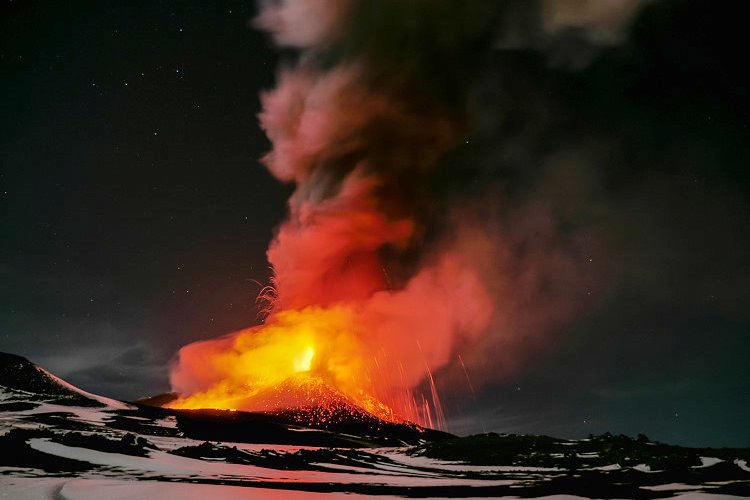
Paroxysm at Mount Etna.
Volcanoes are openings in the Earth's crust. During volcanic eruptions, lava and gases are released through them. Both originate from molten rock known as magma, which forms in the Earth's mantle and rises toward the surface.
Volcanoes are essential components of the Earth's ecosystem and a visible expression of our planet's dynamic nature. Without volcanoes, life on Earth would probably not exist.
More than 1,900 active volcanoes are known worldwide, with many more hidden beneath the oceans. Around 800 million people live in the shadow of these fiery mountains and are directly exposed to a wide range of volcanic hazards. Every year, 40 to 50 volcanoes erupt, making eruptions a regular occurrence. Volcanism shapes the face of the Earth and profoundly influences human life.
From this perspective, volcano videographer and journalist Marc Szeglat reports on the fascinating world of volcanoes and volcanology.
Up-to-date information on volcanic eruptions and natural disasters is published in the news blog.
This website offers general information about volcanoes and volcanology. Additionally, there is a section below that addresses frequently asked questions (FAQs) about volcanoes.
Some pictures are available for download under the free Creative Commons (CC) license.
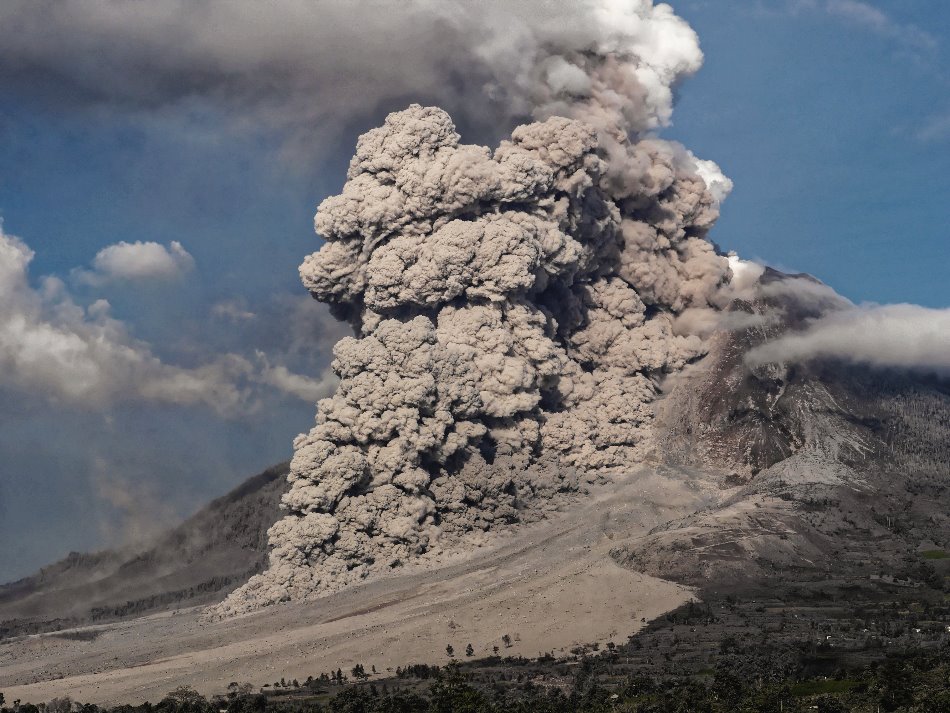
03/16/24: On Iceland's Reykjanes Peninsula, there are other eruptions and dike formations along the Sunhnukur crater series. It looks like Reykjanes has entered a new phase of eruption that could last for several decades.
All news in the volcanoes.de blog.
Paroxysm at Mount Etna.
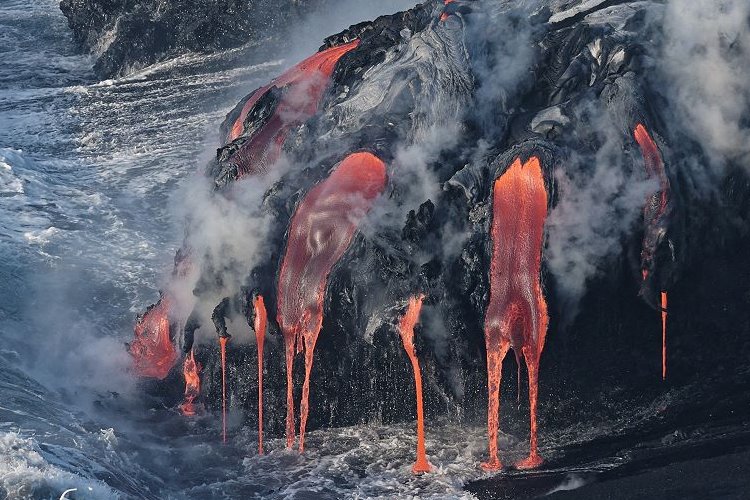
Ocean entry on Hawaii.
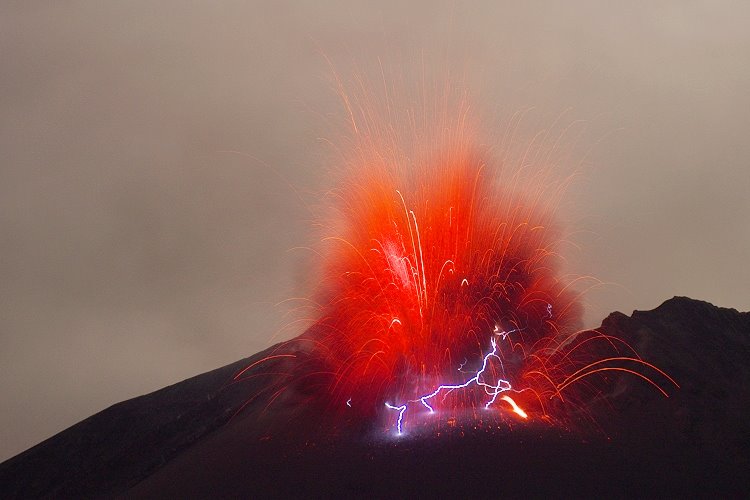
Volcanic lightning at Sakurajima.
Etna
Mount Etna is the most majestic volcano of Europe. With an altitude of 3454 m and a circumference of roughly 150 km it dominates the east coast of Sicily. Etna is one of Italy's most active volcanoes. The Mountain is a complex shield volcano that can erupt in very different ways. Etna is known for its effusive eruptions, which produce large lava flows. While these flows can destroy villages, they are generally not highly dangerous to humans. In recent years, the volcano produced a number of phases with explosiv and effusive paroxysmal eruptions. These eruptions usually begin with strombolian explosions, which intensify in the course of hours or days to high lava fountains. At the beginning of the short-term main phase, a lava flow begins to flow. This reaches relatively high speeds on steep terrain of the peak region. A new crater cone was formed by these paroxysm in recent years. In the spring of 2017, some people were injured when a phreatic explosion occurred. A lava flow came into contact with the melt water of the snow cover, which caused the water vapor explosion.
Campi Flegrei
Campi Flegrei is a large caldera in southern Italy, located within sight of Naples and Mount Vesuvius. In some countries it is better known as the Phlegraean Fields. The caldera was formed by a gigantic eruption with a VEI of 7-8 around 39,000 years ago, when volcanic ash was dispersed as far as northern Europe.
Today, the city of Pozzuoli lies within the caldera, which could erupt again in the future. It contains several craters that bear witness to smaller eruptions in the relatively recent past. The most active crater is Solfatara, where fumaroles and mud pools can be observed. Due to increased activity and a fatal accident, access to the Solfatara has been closed since 2017.
Within just a few years, the ground has risen by more than one meter, and numerous earthquake swarms have occurred. Similar events have been documented for thousands of years and are known as bradyseism. Recently, however, a debate has emerged over whether a major volcanic eruption could be imminent in this densely populated area-an event that could have effects across Europe.
Erta Alé
Erta Alé is a broad shield volcano located in the Danakil Desert of Ethiopia. The summit area features two calderas, formed along the main fault lines of the East African Rift Valley. Within the northern caldera lies a persistent lava lake in a pit crater that has been active for decades. Activity intensified in December 2016, when multiple lava overflows from the lava lake occurred, sending lava flowing through the eastern part of the caldera.
In January 2017, a second lava lake formed in the southern caldera. Since then, two substantial lava flows have emerged, traveling over the volcano's flanks and reaching lengths of approximately 7 and 4 kilometers. Between 2022 and 2025, active hornitos and additional lava flows were observed within the caldera, indicating continued vigorous volcanic activity.
In 2025, Erta Alé experienced a larger eruption event, which caused significant changes in the summit calderas. Both of the previously active lava lakes drained and the craters deepened considerably as they filled with fresh magma below.
Kilauea
Kilauea is located on Big Island, Hawaii. This shield volcano is one of the most active volcanoes in the USA. As a hot-spot volcano in the middle of an oceanic plate, it produces very low-viscosity basaltic lava. Time after time, spectacular lava lakes are formed in the craters Halema?uma?u and Pu'u'O'o. The lava flows are often active for several years and are known to reach the ocean. In 2016, lava flow 61g reached the sea, creating a new lava delta. In January 2017, the lava delta collapsed, and a spectacular lava hose (or rather lava fall) emerged. It was active for several weeks and very popular with tourists.
In 2018, the Leilani Estates eruption caused widespread destruction, as fissures opened across the residential area, releasing large lava flows that buried dozens of homes. This eruption dramatically reshaped the lower East Rift Zone and was one of Kilauea's most significant events in recent decades.
Currently, there is no stable lava lake in the Halema'uma'u crater. Instead, episodic lava fountain activity occurs, gradually refilling the crater, which collapsed during the 2018 Leilani eruption. This ongoing activity continues to attract close scientific attention as the volcano slowly rebuilds its summit structure.
Krakatau
Krakatau is a volcanic island located in the Sunda Strait between the Indonesian islands of Java and Sumatra. It is famous worldwide for its catastrophic eruption in 1883, one of the deadliest and most powerful volcanic events in recorded history. The eruption generated massive tsunamis and atmospheric disturbances, killing over 36,000 people and dramatically reshaping the surrounding landscape.
After the original Krakatau volcano was largely destroyed, a new volcanic island named Anak Krakatau ("Child of Krakatau") emerged in 1927 within the caldera. Anak Krakatau has been highly active ever since, growing steadily through frequent eruptions. In December 2018, a significant sector collapse caused a deadly tsunami that affected nearby coastal communities, claiming hundreds of lives and highlighting the ongoing risks posed by this restless volcano.
Today, Anak Krakatau remains closely monitored due to its unpredictable activity and potential for further hazardous events.
Merapi
Merapi is located very close to the major Indonesian city of Yogyakarta. This volcano is considered high-risk and is closely monitored by volcanologists. Merapi frequently erupts explosively or forms lava domes that can collapse, generating dangerous pyroclastic flows. It is one of the subduction zone volcanoes within the Pacific Ring of Fire.
Typical of subduction zone volcanoes like Merapi is the extrusion of highly viscous magma. Instead of classic lava flows or fountains, this magma piles up as a lava dome at the summit. Over time, the steep edges of the dome become unstable and collapse, or the dome itself breaks down, triggering fast-moving pyroclastic flows. The most deadly recent event occurred in 2010, when pyroclastic flows claimed over 350 lives and traveled up to 20 kilometers.
Since 2023, Merapi has exhibited renewed dome growth accompanied by frequent dome collapses. These collapses have generated several pyroclastic density currents, posing ongoing hazards to nearby communities. The volcano remains highly active, with regular ash emissions and seismic unrest, keeping local authorities and scientists on high alert.
Nyiragongo
Nyiragongo is usually considered one of the relatively harmless-looking volcanoes because of its persistent lava lake that boils inside its crater. However, this lava lake occasionally breaks through faults on the volcano's flanks, sending fast-moving lava flows toward the nearby Congolese city of Goma, causing major destruction. The most recent such outflow occurred on 22&xnbsp;May&xnbsp;2021, when fissures opened on the southern flank and drained the crater lake, producing lava flows that advanced toward Goma and forced thousands of people to flee.
Despite the quieter period, Nyiragongo remains highly active and hazardous due to its history of sudden lava outflows and its proximity to densely populated areas. Scientists continue to monitor seismic signals, gas emissions, and ground deformation to better understand and anticipate future eruptive behaviour at this dangerous volcano.
Ol Doinyo Lengai
Ol Doinyo Lengai, known as the 'Mountain of God' among the Maasai in Tanzania, is a unique volcano for volcanologists due to its production of the coldest lava in the world. The lava, composed of carbonates, resembles mud and reaches temperatures of approximately 500 degrees Celsius. In 2007, Ol Doinyo Lengai erupted with great intensity. Black lava fountains soared high above the crater, while ash blanketed the surrounding area. The Maasai's livestock could not find any grazing grounds and suffered from starvation. A new cone formed within the crater as a result of the eruption. Presently, the volcano's cold lava continues to simmer deep within the pit.
Piton de la Fournaise
Piton de la Fournaise is located on the island of La Réunion in the Indian Ocean. It is one of the most active volcanoes in the world and shares many similarities with Kilauea. Most eruptions are spectacular natural events, but occasionally villages have been destroyed. In recent years, Piton de la Fournaise has erupted roughly three times per year. The last truly major eruption occurred in 2006, when a 1-kilometer-long fissure opened on the outer flank, releasing a huge volume of lava that flowed downhill and reached the sea after several hours.
After a longer pause, a new phase of eruptions began in 2016. The most recent eruption took place in the summer of 2023.
Soufrière Hills
Soufrière Hills in the Caribbean is a dangerous stratovolcano with many domes forming its summit. The last eruptive period ended in 2012. Between 1995 and 1999, a disastrous eruption took place. A lava dome began to grow, and pyroclastic flows devastated the island's capital, Plymouth, which now stands as a ghost town. At least 18 people lost their lives during the eruption. More than 7,000 residents were forced to leave their homes and were resettled elsewhere.
Since the major eruptive phase, the volcano has remained closely monitored due to its ongoing activity and potential for future eruptions. Intermittent dome growth and minor ash emissions have been recorded, keeping local authorities vigilant. The eruption fundamentally changed Montserrat's landscape and economy, with much of the southern part of the island remaining uninhabitable.
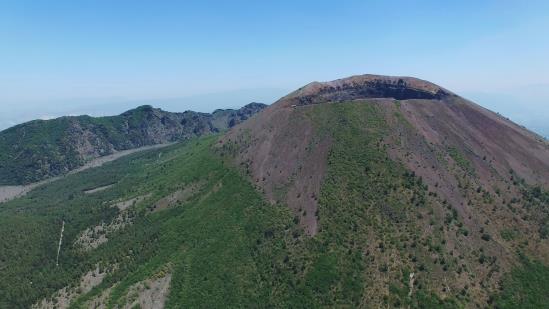 Vesuvius
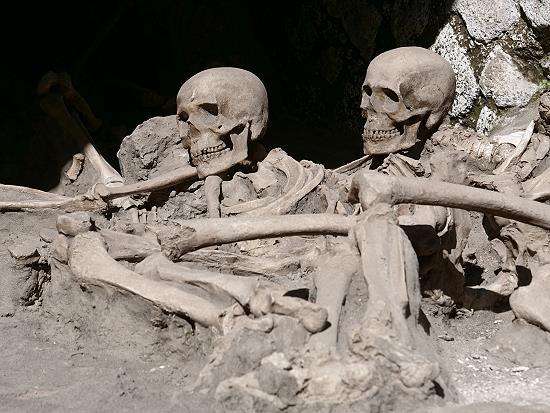
Vesuvius achieved tragic fame when its pyroclastic flows destroyed the Roman cities of Pompeii, Herculaneum and Stabiae in the year 79 AD. The explosive eruptions of Pompeii are powerful: highly rising ash clouds generated gigantic pyroclastic flows that burned all lives two thousand years ago. Archaeologists excavated 2000 corpses. A total of 16,000 victims are expected. Several million people now live in the area around it. Another disastrous eruption is likely. The last eruption in 1944 was explosive and effusive. The ash clouds were not as large as in the time of Pompeii, but lava flows destroyed some villages.
Since then, Vesuvius has been under constant surveillance due to the dense population living nearby. Emergency plans and evacuation strategies are regularly updated to prepare for a future eruption. Scientists continue to study its behavior to better predict any potential activity and minimize the impact on the surrounding communities.
Yellowstone
Yellowstone is the oldest national park in the USA and one of the world's largest calderas. The volcano has the potential for a supervolcano eruption that could drastically alter the global climate and potentially cause mass extinctions. Such cataclysmic eruptions have occurred at intervals of approximately 640,000 years, meaning a new eruption is statistically overdue, though it is impossible to predict exactly when it might happen.
Today, the Yellowstone caldera hosts a unique and dynamic natural landscape, featuring thousands of geysers, hot springs, mud pots, and fumaroles. Among the most famous are the Grand Prismatic Spring, known for its vivid colors, and Old Faithful Geyser, famous for its regular eruptions.
Another remarkable feature is the Steamboat Geyser, the world's tallest active geyser, which can shoot water over 90 meters high during its powerful and unpredictable eruptions. These geothermal phenomena are driven by the underlying volcanic heat and provide valuable insight into the volcano's ongoing activity. Yellowstone remains one of the most closely monitored volcanic systems in the world.
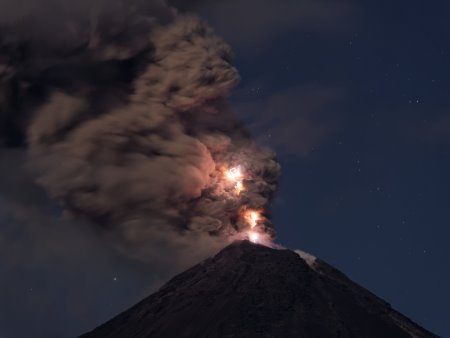
Volcanic lightning at Colima.
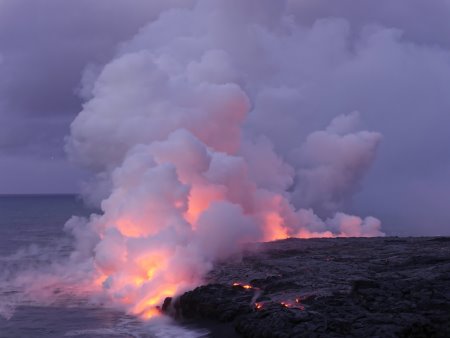
Ocean entry on Hawaii.
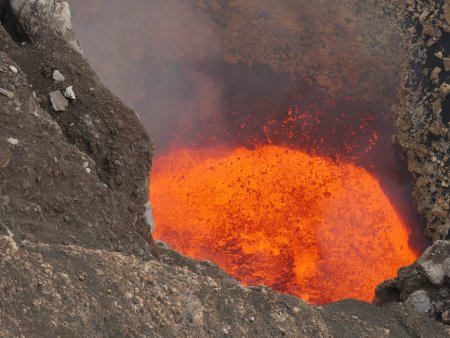
Lava lake at Masaya.
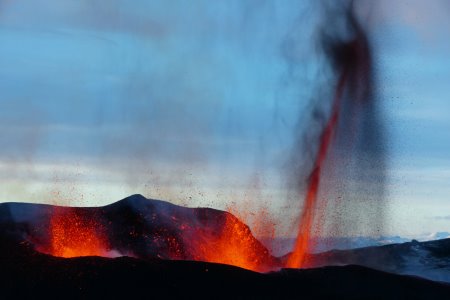
Lava fountain on Eyjafjallajoekull.
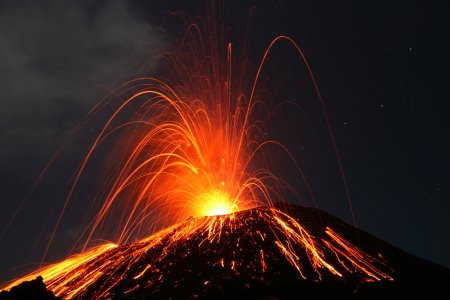
Strombolian eruption at Krakatau.
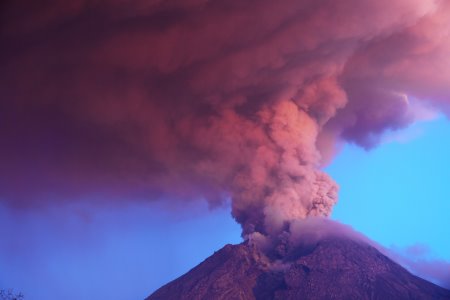
Ash cloud at Merapi.
What is a volcano?
A volcano is an opening in the earth's crust. Molten rock and gases that rise from the earth's mantle escape. The molten rock solidifies and accumulates in the form of lava around the opening. The result is an elevation, or a conical shaped mountain referred to as a volcano.
What takes place during a volcanic eruption?
During the ascent of magma to the surface, the principle of hydrostatic pressure relief takes place. Magma is less dense than the surrounding rock and it begins to rise like an air bubble in water. During ascent the external pressure on magma decreases and it is decompressed. Gases that till this point had been dissolved in the magma escape like the opening of a champagne bottle. Once at the surface, lava is expelled into the air by excess gas pressure and the volcano erupts.
Where does the lava come from?
Lava which is still underground and contains much gas is referred to as magma. This is primarily generated by the partial melting of silicate rocks in the earth's mantle. Magma can also form due to the melting of subducted earth crust which occurs along the plate boundaries. Mainly the chemism of the magma determines whether the volcano erupts effusively, or explosively.
What is lava made of?
The main component of lava is silicon dioxide (SiO2, silicic acid). Depending on the origin of the magma, the lava roughly contains between 40 and 70% SiO2. Depending on the SiO2 content, we then also speak of basic, intermediate and acidic magmas. The solidified lava rock is now formed by crystallization of a silicate melt (the magma) and is ultimately composed of crystals of various minerals. The main components of these minerals are silicon and oxygen, as well as elements such as iron, aluminium, magnesium, calcium and sodium. Common minerals are plagioclase, quartz, olivine, pyroxene, amphibole, and biotite.
Very rare are lavas, whose basic mass consists of carbonate instead of silicon dioxide. This lava is recently extracted at Ol Doinyo Lengai in Tanzania.
How hot is lava?
Depending on the composition of the lava and the depth and the speed at which the magma rises, the temperature of lava can vary between approximately 500 ° C and 1250 ° C. The coldest lava found on a volcano was 450 ° C hot. This temperature was meassured on Ol Doinyo Lengai in Tansania. The hottest lava I know was erupted from Piton de la Fournaise during the eruption in 2007.
How is the temperature of lava measured?
Most often, long probes made of nickel-chrome alloy are used, connected to a thermometer. The probes must be held in the lava for a few seconds. If the lava cannot be approached, the temperature is measured with infrared sensors. To control the heating of a volcano over a large area, temperatures can be measured using infrared images from satellites.
How fast can lava flow?
This is dependent on the composition of the lava, its temperature and the concentration of crystals it contains. In general, the more silicon dioxide contained in lava, the colder lava is and the more crystals and bubbles lava contains, the slower the lava. It can become so tough that it no longer flows, and become lodged in the crater (doming) like a brittle cork. At the other extreme are low-viscosity, hot lava flows (pahoehoe lava on Hawaii) that can reach speeds of 100 km / h on steep slopes.
Can you walk on flowing lava?
A question that is asked frequently. The amazing answer is: yes, it is conditionally possible. Normally, lava is able to carry a certain load, unless it is extremely hot and fluid lava like in Hawaii, or the coldest lava in the world. This is found at Ol Doinyo Lengai. There a student once burned his foot when he stepped into the non-glowing lava. I was once able to film on Etna how a man ran over a flowing lava stream. You can see the clip at the Etna videos. But such a thing is not recommended for imitation, the danger of burning is high!
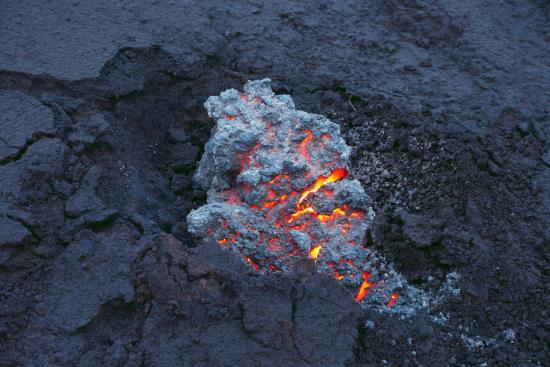 How far can lava fragments fly out of a volcano?
That depends on the size of the particles and the gas pressure in the magma. Large fragments of rock, so-called bombs, usually do not hit so far from the crater, but can fly several kilometres in strong eruptions.
Pebble-sized volcanic rocks, the lapilli, can be hurled many kilometres away. Fine particles are called volcanic ash. This can rise up to the uppermost layers of the atmosphere and be transported by the wind over thousands of kilometres.
Aerosols remain in the stratosphere for years and can influence the climate. An umbrella protects from ash rain, a helmet from lapilli. The only protection against bombs like the one in the picture is a beton roof.
Where are most volcanoes located?
Most volcanoes form along the continental margins and along the plate boundaries around the Pacific Ocean. This region is therefore referred to as the "Ring of Fire". Many volcanoes extend along divergent plate boundaries such as the mid-ocean ridges. Volcanoes also occur along continental fault zones such as the East African Rift Valley. There are also "hot spot" volcanoes such as Hawaii and Yellowstone which are formed by mantle plumes that rise from the core-mantle boundary.
Are there active volcanoes in Europe?
Yes, there are a few. The closest to us are the active volcanoes in southern Italy. The best known are Vesuvius, Stromboli and Etna. Etna is the largest volcano in Europe and one of the most active worldwide. It is also a popular tourist destination. It often erupts several times a year.
Iceland has many active volcanoes. Many of them lie under the ice of the glaciers. Subglacial volcanoes are Grimsvötn, Bardarbunga and Eyjafjallajökull. The last one erupted in 2010. Bardarbunga became active in September 2014.
What volcanoes are located near Germany?
In our vicinity there are the volcanoes of the Eifel, among which the youngest volcanoes of Germany can also be found. Not far away are the volcanoes of the Upper Rhine Graben which continues in the Lower Hessian depression. The Kaiserstuhl, the Vogelsberg and the Westerwald lie on a continental rift zone of a rift. In Lusatia today we find the remains of a typical intraplate volcanic province. Among the most famous outcrops are the basalt columns of Stolpen Castle not far from Dresden. Active volcanoes in our vicinity are Etna and Stromboli in southern Italy.
Can the Eifel volcanoes still erupt?
The Eifel volcanoes have formed over the past 700 000 years, the youngest are only 10 000 years old. Although an eruption is not expected in the near future, in the long term eruptions in the Eifel are extremely likely. A special case is the Lacher See volcano, which was responsible for the largest Quaternary volcanic explosion in Central Europe 12 900 years ago. A magma chamber from which volcanic gases escape is still located under the lake area today. These manifest themselves in mofettes on the eastern shore of Lake Laach
How high is the biggest volcano?
The highest volcano on a continent is the 6885 m high Nevado Ojos del Salado in Chile. The highest volcano on earth is the shield volcano Mauna Loa in Hawaii. Mauna Loa rises from the bottom of the Pacific Ocean, which here is about 5000 m deep. Together with the 4139 m above sea level, the volcano is over 9000 m high and thus even the highest mountain on earth.
What is the most dangerous hazard on volcanoes?
Pyroclastic flows are the main hazard during ash rich eruptions and pelean eruptions on dome volcanoes. If a lava dome, or a huge ash cloud collapse may result in an avalanche of volcanic ashes, blocks and gases. These avalanches can reach speeds up to 400 km / h and be hot over 800 degrees Celsius. Pyroclastic flows can travel long distances and flow over water.
Rising ash clouds pose a serious hazard to air traffic. The ash can destroy the engines and the cockpit-windows. The volcanic ash can cover fields and can lead to bad harvests. Ash eruptions in connection with heavy rain can cause lahars. These are a type of mudflow and debris flow which are able to bury whole communities. Wet ash is so heavy that the roofs of the houses collapse.
In case of an explosive eruption tephra is able to endanger people close to the volcano. An impact of a lava bomb is mostly deadly, if persons hit directly.
Lava lakes and lava flows only rarely kill people. But fast moving lava flows can do it. They can also destroy homes and entire towns. Of course you should not plunge into a lava lake.
What were the worst volcanic disasters?
 One of the worst volcanic disasters was the Toba eruption on the Indonesian island of Sumatra. This so-called super-volcanic eruption occurred about 72,000 years ago and almost wiped out the entire human race.
Dramatic volcanic eruptions occurred in the Bronze Age, when the eruption of Santorini initiated the downfall of the Minoans. In Roman times there was a devastating eruption of the volcano Vesuvius in the Gulf of Naples. The cities of Pompeii, Herculaneum and Stabiae were destroyed.
In the 18th century, two fissure eruptions caused suffering to the population: Laki in Iceland and the Montañas del Fuego in Lanzarote.
In 1815, the Indonesian volcano Tambora erupted on a large scale and the following year is considered to be the year without a summer, as there was a worldwide drop in temperature. The Tambora erupted the unimaginable magma volume of 90 cubic kilometres. Even in the Alps there were crop failures and people were starving. The volcanic eruption killed 92,000 people.
Another Indonesian volcano erupted in 1883: Krakatoa. The volcanic island destroyed itself in a massive volcanic eruption, creating pyroclastic flows and tsunamis in which more than 36,500 people died.
Among the greatest volcanic catastrophes of the recent past are the eruptions of Mt. St. Helens in the USA, and Mt. Pinatubo and Mayon in the Philippines. In November 2010, Merapi erupted in Indonesia, killing more than 350 people. The eruptions of Chaiten volcano in Chile and Eyjafjallajökull in Iceland also made headlines. The eruption of this volcano caused a flight ban over Europe for several days in 2010. The financial damage was enormous, but people did not die.
How likely is the eruption of a supervolcano such as Yellowstone?
In the media, the term "supervolcano" is often used and associated with an imminent eruption of the Yellowstone volcano. It is true that a volcanic eruption in the Yellowstone Caldera is statistically overdue and that magma is moving in the caldera underground which leads to the swelling of the caldera floor and the emergence of new hot springs. However, local volcanologists agree that a volcanic eruption is not imminent.
Is there a connection between volcanoes and earthquakes?
Earthquakes usually occur in the same zones where volcanoes exist: along tectonic plate boundaries and fault zones. Strong tectonic earthquakes are suspected to cause volcanic eruptions. A prerequisite for this seems to be that the volcano is already ready for an eruption. Furthermore, there are earthquake types that are directly related to eruptions. They occur when the rising magma makes its way through the underground and causes the rock to burst. In addition, a volcanic eruption itself can cause a continuous quake of the earth, which is called tremor.
Volcanic records
The highest volcano on mainland is Nevado Ojos del Salado in Chile. This volcano is 6885 m high. Its last big eruption took place 1000 years ago. Today the volcano is in a stadium of fumarolic activity.
The highest volcano on world is Mount Mauna Loa on Hawaii. The volcano rises 4139 m above the pacific ocean but from its base on the ground of the sea Mauna Loa measures more than 9000 m. Mauna Loa is the highest Mountain on earth. Another volcano on Hawaii is Kilauea. This is the most active volcano in the USA and for more than 30 years in almost permanent eruption.
The loudest sound on earth in historical time was produced by the volcano Krakatau. In 1883 Krakatau exploded in a huge eruption. Pyroclastic flows and tsunamis were generated and more than 36.000 people lost their live in this disaster. The explosion bang was heard in a distance of 4700 km
Volcanism and tourism
Many people wonder if it is possible to spend a vacation in volcanically active areas, or to climb a volcano to watch its eruptions. Both is possible, but with caution and under expert guidance. Many vacation regions are actually close to active volcanoes and you don't even have to travel to far away countries like Indonesia or Japan. It is enough to visit the Canary Islands, or Sicily and you are close to active volcanoes. On Etna, volcano tourism is booming: travelers are taken by cable car and bus to the volcano. But only rarely do day tourists have the luck to see an eruption. At Stromboli on the Lipari Islands, however, you will most likely witness a strombolian eruption. But you have to climb the volcano on foot. Tourism is also well developed at Fuego in Guatemala. This volcano is practically permanently active and relatively safe to climb. In the chapter about volcano tours you can read more about this topic.
What purpose do volcanoes serve?
Without volcanism, there would probably be neither a stable crust nor life on earth. The volcanoes have the function of overpressure valves and ensure that the earth's crust does not constantly burst open arbitrarily: radioactive decay, high pressure and chemical processes generate heat in the earth's interior. By subduction of oceanic crust and heat, magmas and fluids are formed which expand and have to go somewhere. They escape relatively controlled through the volcanoes. The mid-oceanic ridges play a special role: along the submarine spreading zones new ocean crust is formed from the magma.
The volcanoes not only transport important minerals from the depths of the earth to the surface, but also gases and heat. Most of the gas is water vapor. According to one theory, volcanoes sweat out the water of the oceans and also created the primeval atmosphere. That was in the Archaic Age. According to another theory, the water reached the earth via ice meteorites. From a diplomatic point of view, the water could have reached the earth's surface through both types. Other important factors are volcanic minerals and geothermal energy: first life formed in the form of archaeobacteria in the area of thermal springs. These thermophilic bacteria fed on sulfur compounds as they promote volcanoes. The archaeobacteria developed into cyanobacteria (blue-green algae) which produced oxygen by photosynthesis and so life took its course.